
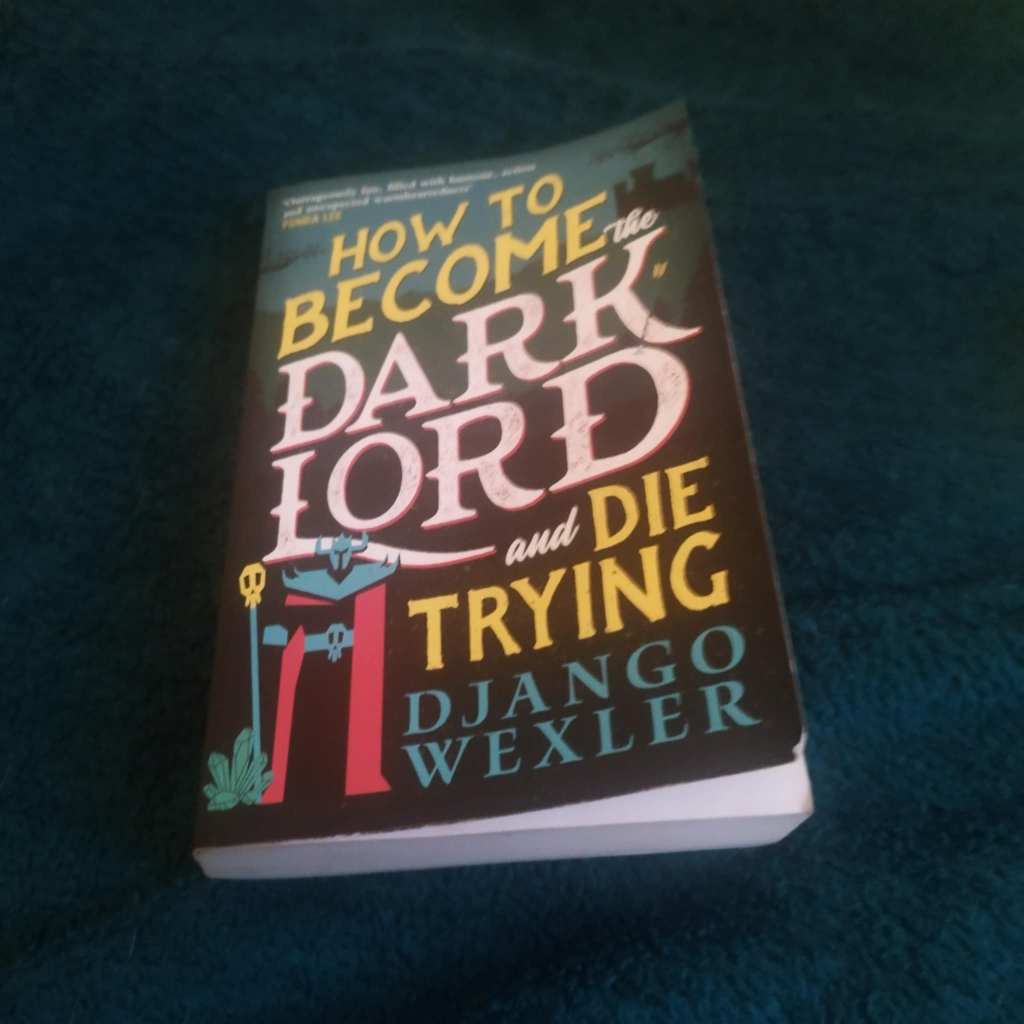
Recently I wrote about my ongoing Christmas tradition of the Christmas book fund. One of the books I was looking forward to reading the most from the 2024 fund was How to Become the Dark Lord and Die Trying, which I pre-emptively described as looking “like a lot of fun”. Having now read the book; I now realise that it far exceeds my expectations. Brilliantly funny, devilishly vulgar, and surprisingly emotional at times, this time-twisting, genre breaking adventure will leave you laughing and crying throughout as the Dark Lord-in-waiting Davi travels across deserts and mountains, gets dragged into political schemes and deadly battles, and adds more varied and bizarre allies to her ever-increasing horde. It even has footnotes![1]
The greatest strength of How to Become the Dark Lord and Die Trying is how it subverts and satirises many tropes of the fantasy genre. The prophesised Chosen One, destined to save the world, is quickly discarded as Davi, jaded by countless attempts to fulfil this apparent destiny, decides to become the Dark Lord that she has been attempting to stop from rising for centuries instead. The regular dynamic between humans and orcs is flipped as the orcs (and a myriad of other creative fantasy races and cultures) become the focus of the story. Throughout the story many of these characters become friends, lovers and enemies to Davi as the orcs are given character arcs and motivations normally reserved for the humans in these adventures. Alternatively, the humans take the role normally reserved for the orcs in a fantasy narrative. An unstoppable force of destruction, humans are feared and mythologised by some of the orcs, and other fantasy races, to the point where they can meet a human character in Davi and not realise that they are in fact talking to a human, due to the exaggerated nature in which their horror stories depict them.
Davi herself is a fascinating character. Inspired by the isekai[2] trend in anime, Davi is an anachronistic blot in the pages of the high fantasy world she has found herself in. Ever cracking jokes and making cultural references that naturally go straight over the head of any other character, Davi’s fourth wall breaking narration is one of the funniest I have read in a long time. However, the character is much more complex than just jokes and references. Thousands of years of deaths and heartbreaks, the trauma of repeated time loops forcing her to relive and lose friendships and relationships that are always seemingly doomed to a tragic[3] end. Thus, Davi feels more than just a character, her fears and her hopes and her goals are woven beautifully into the pages, her reactions and emotions as the story and world twist around her hit hard as though you are experiencing them with her.
The chapters in this book are long. Imagine my surprise, when after saying I’d just read one more chapter, that said next chapter turned out to be 52 pages long! While this may seem excessive and inaccessible, there are regular breaks in the chapters that serve as a natural point to take a rest for anyone who needs it. However, despite the length of the chapters, it never felt overly long to me. Every chapter is so full of action, romance, humour, and intricate plotting that it never feels like you are reading a very long chapter, as it just seems to fly by as you read. Onto the topic of footnotes[4], this is the first time I have experienced the use of them in a work of fiction, and they are used to fantastic effect in How to Become the Dark Lord and Die Trying. With varied use, from expanding a joke in the main text to providing useful information about the world, the footnotes are often the best part of any page they appear in, to the point where I was often tempted to read them before I got to the point where they are in the story.
How to Become the Dark Lord and Die Trying is a hilarious reimagining of high fantasy tropes. It is a deeply inventive satire that keeps the laughs coming at an incredible pace through dark humour, cultural references, and a use of footnotes that I have never seen before in fiction but hope to see more in books that I read in the future. It is brutal, funny, and surprisingly emotionally hard hitting at several points, with some truly shocking twists and turns too. How to Become the Dark Lord and Die Trying will undoubtably be one of the best books I will read this year, if not the best.
[1] I’ll talk more about this later in the review.
[2] Isekai is often a story where an ordinary person is transported to a fantasy world, with strange rules and people.
[3] And often very painful.
[4] See! I told you I’d get back to it! *Is using footnotes when talking about a book with footnotes a bit too obvious? Oh well, I’m going to do it anyway.
 Ben & Books
Leave a comment