
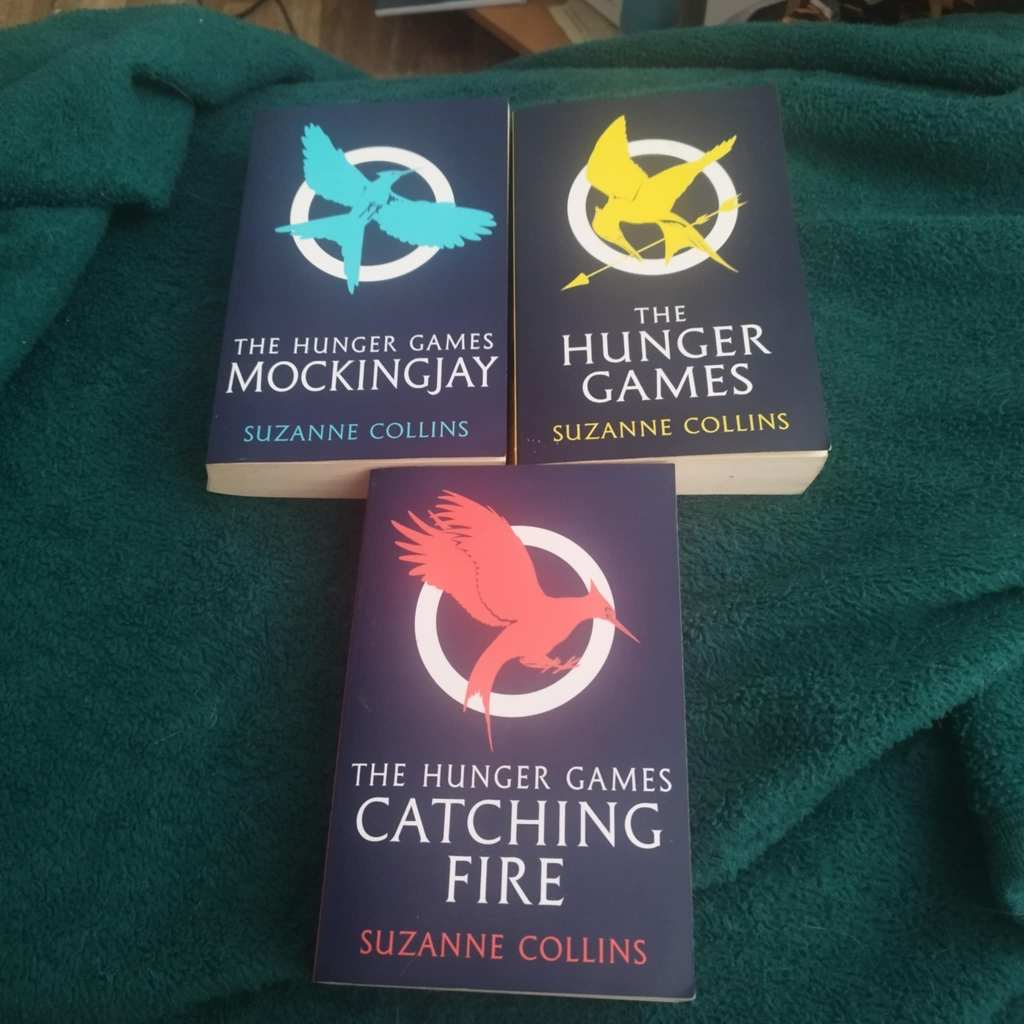
My first experience of The Hunger Games was ten years ago, when after the release of Mockingjay Part 2, I watched all the movies. Shortly after the last movie was released, I watched all four of them and unfortunately found them to be quite underwhelming. For some reason, whether it was how the movies were made, or the story did not resonate with me, I couldn’t bring myself to enjoy the movies in 2015. Due to this I had no intention of reading the books. I thought that as I had not enjoyed the movies, that I would similarly not enjoy the books. How wrong I was. Last year a good friend of mine suggested that I give them a try, and shortly after I picked up the Hunger Games for the first time. The books had the complete opposite effect, and after reading the first book, I became a big fan of the series.
The world of the Hunger Games is bleak. Panem is a depressingly dark and disturbingly familiar dystopia. The people of Panem are exploited, abused, and killed in a system where only a select few elites live lives of luxury in the Capitol. This is made considerably worse with the titular yearly Hunger Games, where the Capitol takes one boy and one girl from each district, sacrificing them in arena combat as punishment for a war that ended decades ago. The Hunger Games follows Katniss, a citizen of District 12, the poorest and most oppressed District in Panem. As a result, the world feels alive, dangerous, and desperate as you see the people struggling to survive, the power the Capitol holds over the people, and the deadly consequences that disobedience and rebellion brings to the people of Panem.
Outside of the action and violence of the games, the most interesting and thrilling scenes in The Hunger Games is through the politics that are going on behind the scenes. The biggest battle fought in Panem is through propaganda, from the Capitol using fake news and edited footage to gaslight the people of Panem and the rebels using propaganda videos to rile up the ordinary people into revolution, to Katniss and Peeta using the public interest in their relationship to stay alive. The Hunger Games are not just fought in the arena, but in the media and in the government itself. This threat is best shown through the villainous President Snow. Foreboding, clever, and cruel, Snow is an ominous threat that hangs over Katniss throughout the trilogy. He doesn’t need to be in the room to be scary, but when he is, he feels like a paralyzing force of nature, a bloodsucking horror movie monster in human form. While the action of the games might be the main selling point of the series, these political moves and propaganda between the violence are what makes the Hunger Games so compelling, seeing the revolution in action might be cool, but watching the revolution build through the desperation, anger, and hope of the people reach their boiling point is truly exhilarating.
The Hunger Games is a fantastic opener to the series. The world of Panem is beautifully introduced through the eyes of Katniss and District 12. From the opening chapters Katniss is a symbol of the coming revolution. From intentionally breaking the oppressive laws of the Capitol to openly challenging the concept of the games through subtle acts of defiance in the build to, and during the games. As a citizen of the poorest district, the odds are forever against Katniss throughout the book, this makes her fight to stay alive in the games, and in the politics and propaganda before the games, so much more compelling, as we all know how unlikely survival is for Katniss.
Catching Fire is an excellent continuation from the events of the Hunger Games. Consequences are suffered, politicians plot and plan in the background, and the revolution begins. In Catching Fire, everything that happened previously evolves and twists in captivating ways as Katniss and Peeta struggle to come to terms with what happened to them in the games and Katniss’ multiple acts of defiance have a potentially devastating effect, as a furious President Snow looms ominously in the background and the seeds of revolution begin to grow in Panem as a direct response. Catching Fire is a perfect bridge to set up the end of the trilogy.
Mockingjay ends the trilogy beautifully. Action packed, emotionally devastating, and full of unpredictable and unbelievable twists, this book takes everything set up in the previous two books and does everything it can to hurt you with it. Everything is bigger in Mockingjay, the violence has erupted from the confines of the arena to the entire of Panem, characters are given extra depth, often through heartbreaking back stories, and the propaganda battle becomes country wide. Catching Fire also brilliantly concludes Katniss’ evolution from unremarkable district girl to the symbol of the revolution. This book hurts you. You read along as bad things happen to people you like, and you desperately hope that they will find a way to win and be happy at the end. Mockingjay is the perfect end to an excellent trilogy that I wish I had read much earlier than I did.
As I started reading the Hunger Games trilogy 15 years after the final book, and 10 after the final movie, came out, I am definitely a newcomer to the series. However, I have never felt like that. Since opening The Hunger Games last year, I have felt like I have been a part of the fandom from the very beginning. The trilogy of books is so compelling, so exciting, and so heart-breaking, that it has even made the movies that I previously not enjoyed so much infinitely more enjoyable, due to the connections that I have formed with the many characters throughout the series. Since reading these books, I have read and loved both prequels, rewatched and enjoyed every movie, and even attended a midnight release for the new book, Sunrise on the Reaping. I may have arrived late to the Panem party, but I am incredibly excited to see what comes next for this excellent series.
 Ben & Books
Leave a comment